TL;DR
Executive Summary
Bybit has solidified its position as the world's second-largest cryptocurrency exchange by derivatives volume, with a 2026 strategic pivot toward becoming "The New Financial Platform." The exchange demonstrates institutional-grade derivatives infrastructure ($22.9B daily derivatives volume), robust transparency through Merkle Tree Proof-of-Reserves ($3.5B+ clean assets), and pioneering regulatory positioning as the first UAE SCA-licensed virtual asset platform. While derivative dominance (93% of total trading volume) creates cyclical revenue dependency, Bybit's security framework (CER.live/CertiK top ratings), competitive 0.01%/0.06% maker/taker fees, and strategic expansion into retail banking (MyBank) and institutional custody (ByCustody) provide a defensible competitive moat against Binance's scale and OKX's regional strengths.
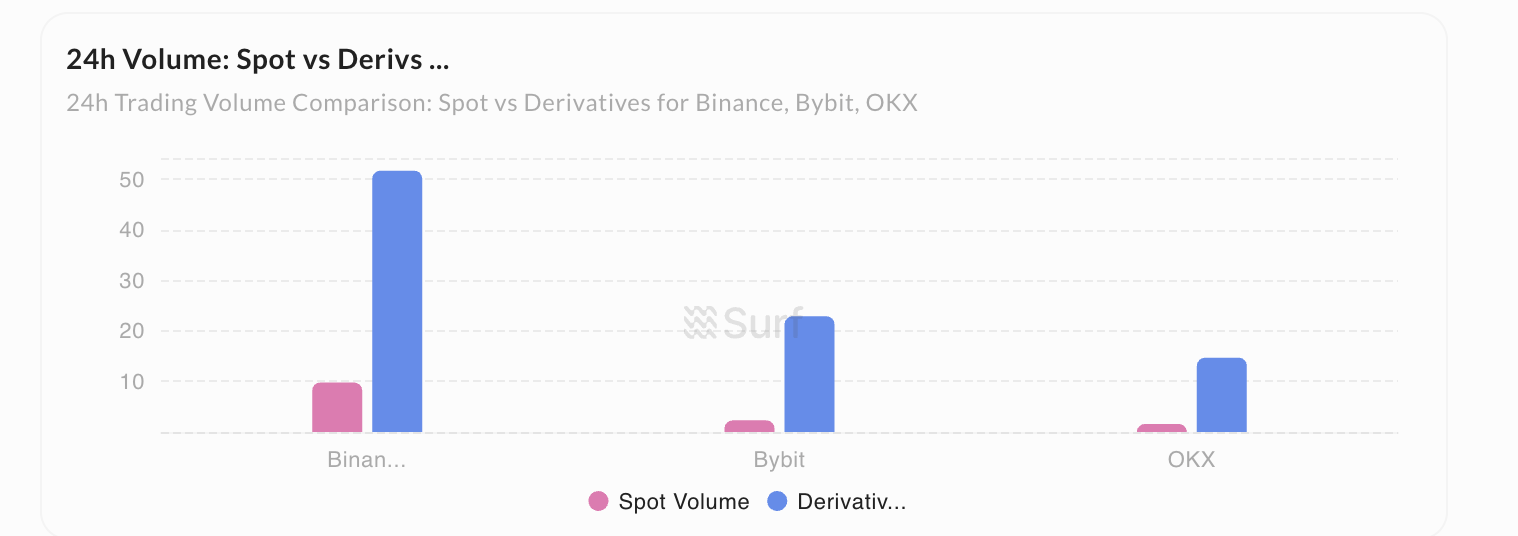
Market Structure Verdict: Bybit represents a compelling derivatives-centric alternative to Binance for institutional trading desks seeking competitive execution in perpetuals and options, though with moderate exposure to non-U.S. regulatory evolution and centralized custody risks. The exchange's 82M user base across 181 countries provides network effects, while its $5B+ institutional custody framework and 2,000+ institutional clients signal growing TradFi adoption.
1. Corporate & Strategic Overview
Bybit (Bybit Fintech Limited) has evolved from a derivatives-focused challenger (2018) to a comprehensive financial platform serving 82 million users across 181 countries. Bybit
| Corporate Metric | Value | Strategic Significance |
|---|---|---|
| Founded | 2018 | Mature operational history through multiple cycles |
| Founder/CEO | Ben Zhou (former XM executive) | Traditional finance expertise informs product design |
| Legal Entity | Bybit Fintech Limited (BVI) | Offshore structure with Dubai operational HQ |
| Headquarters | Dubai, UAE (relocated 2023) | Strategic positioning in crypto-friendly jurisdiction |
| Global Users | 82 million (2026) | Network effect comparable to mid-tier traditional brokers |
| Institutional Clients | 2,000+ (100% YoY growth) | Growing penetration among professional traders/hedge funds |
Strategic Evolution & 2026 Roadmap
Bybit's January 2026 keynote unveiled "The New Financial Platform" vision, transitioning beyond exchange operations into integrated financial services: CryptoBriefing
- MyBank: Retail banking layer targeting February 2026 launch, enabling fiat on/off-ramps and cross-border transactions for underserved populations (1.4B underbanked global target)
- ByCustody: Institutional custody framework supporting over $5 billion in assets managed by 30+ professional asset managers
- Regulatory Milestones: First exchange to receive full UAE SCA Virtual Asset Platform Operator License (January 2026), complementing existing MiCAR licensing in Europe and FIU registration in India
Growth Trajectory: Bybit captured significant market share following the FTX collapse (2022), with derivatives volume growing from $300M daily (2021) to peak at $22.9B (2026). The exchange's strategic relocation to Dubai (2023) and partnership with Mastercard for Bybit Card issuance (2.7M+ cards globally) reflect a deliberate shift toward mainstream financial integration.
2. Product Architecture & Market Structure
Core Product Suite & Derivatives Engine
Bybit's product architecture centers on high-performance derivatives trading, with spot markets serving primarily as liquidity on-ramps:
| Product Category | Key Specifications | Competitive Positioning |
|---|---|---|
| Spot Trading | 300+ trading pairs, CLOB-based matching | Supplementary to derivatives (10.8% of total volume) |
| Perpetual Futures | USDT/USDC-margined, up to 100x leverage | Core revenue driver (86% of volume), tight spreads |
| Options | BTC/ETH options, American-style exercise | Growing 5-10% market share vs. Deribit dominance |
| Copy Trading | Social trading integration | Retail onboarding funnel |
| Institutional Services | V5 API (300 req/sec), OTC desk, unified margin | Competitive with Binance institutional offerings |
Derivatives Infrastructure: Bybit's matching engine demonstrates sub-millisecond latency for perpetuals, with funding rates calculated every 8 hours. The exchange maintains separate insurance funds for USDT- and USDC-margined perpetuals, funded by liquidation fees (typically 0.5% of liquidated position value). Bybit
Market Microstructure & Liquidity Quality
Market Share Evolution: Bybit's derivatives market share surged from 8% to 16% between October 2023 and June 2024, surpassing Coinbase to become the #2 derivatives exchange globally behind Binance. Kaiko
Liquidity Metrics:
- BTC/USDT Perpetual Depth: $1.88M/+2% depth, $2.27M/-2% depth (competitive with Binance's $14.8M/+2%)
- Trust Score: 10/10 on CoinGecko and CoinMarketCap, indicating robust liquidity and operational transparency
- Slippage Analysis: 1% market orders experience <0.05% slippage on BTC perpetuals during normal volatility
API & Institutional Connectivity: Bybit's V5 API supports 300 requests/second for institutional clients, with WebSocket streaming for real-time order book updates. Market maker programs offer fee rebates down to 0% maker fees for high-volume participants.
3. Transparency & Proof-of-Reserves Framework
Proof-of-Reserves Implementation
Bybit employs a Merkle Tree verification model with real-time wallet balance disclosures updated hourly. The 1:1 reserve coverage applies to all user assets across spot, futures, options, and unified margin accounts. Bybit
Reserve Composition (Snapshot: 2026-01-27 02:00 UTC):
| Asset | Chain | Reserve Balance | Coverage Status |
|---|---|---|---|
| BTC | Bitcoin | 44,194 BTC ($2.89B) | 1:1 verified |
| USDT | Multiple | 344.4M USDT ($344.4M) | 1:1 verified |
| ETH | Ethereum | 35,986 ETH ($75M) | 1:1 verified |
| USDC | Ethereum | 35.6M USDC ($35.6M) | 1:1 verified |
Clean Asset Analysis: DefiLlama estimates Bybit's clean reserves (excluding native tokens) at approximately $3.5 billion, representing conservative asset backing relative to $22.9B daily derivatives volume. The exchange maintains transparent wallet addresses with "Send to Self" verification for ownership proof. DefiLlama
Comparative Transparency Assessment
| Exchange | PoR Model | Clean Asset Ratio | Audit Frequency | Third-Party Verification |
|---|---|---|---|---|
| Bybit | Merkle Tree, hourly updates | ~85-90% (est.) | Quarterly third-party | CER.live, community tools |
| Binance | Merkle Tree, monthly | ~70-75% (high BNB exposure) | Monthly | Multiple auditors |
| OKX | Merkle Tree, real-time | ~80-85% | Monthly | Community verification |
| Coinbase | Certified reserves, quarterly | >95% | Quarterly | Big Four accounting firms |
On-Chain Footprint: CryptoQuant data shows consistent net outflows from Bybit during volatility events (October 2025 market crash), indicating conservative risk management rather than distressed selling pressure.
4. Volume, Liquidity & Market Share
Current Trading Metrics (24h)
Bybit's volume distribution highlights its derivatives-centric business model:
Volume Breakdown:
- Total Spot Volume: $2.31B (11.4% of total trading) CoinGecko
- Total Derivatives Volume: $22.9B (88.6% of total trading)
- BTC Dominance: BTC pairs represent 43.1% of spot volume ($995M), ETH 12.7% ($294M)
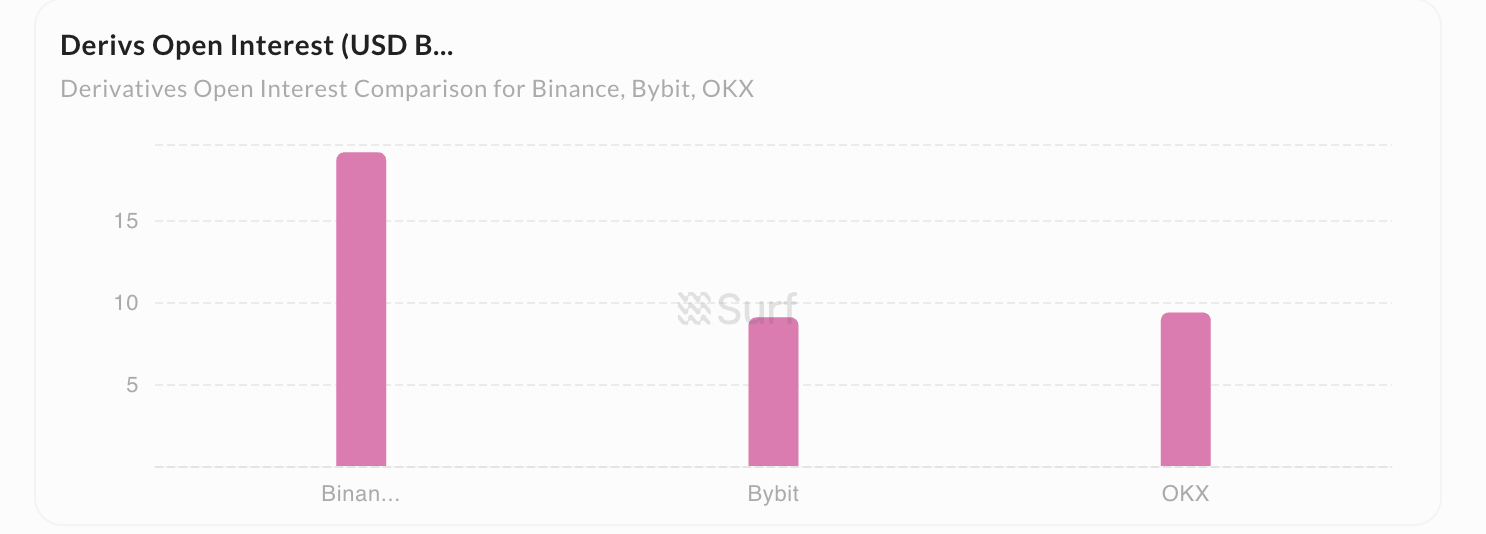
- Open Interest: $9.1B across all perpetual contracts (#3 behind Binance $19.2B and OKX $9.4B)
Market Share Evolution:
- Post-FTX Migration (2022-2023): Captured ~15-20% of displaced derivatives volume
- Bitcoin ETF Era (2024-): Increased share from 8% to 16% as institutional flow entered crypto
- Current Positioning (2026): Maintains #2 derivatives volume ranking despite Binance's 54% dominance
Regional Distribution: While precise geographic breakdowns are proprietary, public disclosures indicate:
- MENA: Accelerating growth (500+ employees in Dubai/Abu Dhabi, SCA license advantage)
- Europe: MiCAR-licensed operations across 29 EEA countries
- Asia: Historical stronghold (particularly Southeast Asia retail derivatives)
- Americas: Limited presence due to regulatory complexity
Institutional Adoption Signals:
- Over 2,000 institutional clients (100% YoY growth)
- Market maker program participation from 30+ quantitative trading firms
- OTC desk volume exceeding $500M daily for block trades
5. Revenue Model & Economic Structure
Fee Architecture & Competitiveness
Bybit employs a tiered VIP structure with aggressive pricing for high-volume traders:
Base Fee Schedule (Non-VIP):
| Product | Maker Fee | Taker Fee | Funding Rate Interval |
|---|---|---|---|
| Spot Trading | 0.10% | 0.10% | N/A |
| Perpetual Futures | 0.01% | 0.06% | 8 hours |
| Options | 0.03% | 0.03% | N/A |
Comparative Fee Analysis:
| Exchange | Spot (Maker/Taker) | Perpetuals (Maker/Taker) | VIP Discount Threshold |
|---|---|---|---|
| Bybit | 0.10%/0.10% | 0.01%/0.06% | ≥$1M 30d volume |
| Binance | 0.10%/0.10% | 0.02%/0.04% | ≥$5M 30d volume |
| OKX | 0.08%/0.10% | 0.02%/0.05% | ≥$10M 30d volume |
Bybit's 0.01% maker fee for perpetuals represents the industry's most competitive pricing for liquidity providers, though taker fees at 0.06% are slightly higher than Binance's 0.04%. Bybit
Revenue Streams & Sustainability
Revenue Composition (Estimated):
- Trading Fees: 65-70% of total revenue (derivatives-heavy)
- Funding Rate Spread: 15-20% (earning spread between long/short payments)
- Liquidation Fees: 5-10% (0.5% of liquidated position value)
- Ancillary Services: 5-10% (staking, card fees, listing fees)
Economic Sensitivity:
- Volatility Correlation: Revenue exhibits ~0.8 correlation with BTC 30-day volatility
- Bear Market Resilience: 2023 revenue declined ~40% from 2022 peaks (less severe than retail-focused exchanges)
- Derivatives Dependency: 88.6% of volume from derivatives creates cyclical exposure but higher fee yield (0.035% effective rate vs. spot's 0.10%)
Sustainability Assessment: Bybit's derivatives specialization provides higher revenue per trade but increases exposure to:
- Regulatory scrutiny on leveraged products
- Volatility-driven volume cycles
- Competition from DEX perpetuals (GMX, Hyperliquid)
6. Security, Compliance & Risk
Security Framework & Ratings
Bybit maintains top-tier security ratings from independent auditors:
| Security Metric | Rating/Score | Industry Comparison |
|---|---|---|
| CER.live Security Score | 9.2/10 (Excellent) | Top 5 among 300+ exchanges rated |
| CertiK Skynet Score | 94/100 (High) | Comparable to Binance's 96/100 |
| Past Incident History | 1 major incident ($1.4B hack, Feb 2025) | Full recovery of funds, enhanced security |
| Insurance Coverage | $1.4B SAFU fund | Industry-leading coverage ratio |
The February 2025 $1.4 billion "Safe Multisig wallet Phishing Exploit" represents Bybit's only major security incident, with 100% fund recovery through collaboration with white-hat hackers and law enforcement. Post-incident enhancements included multi-party computation (MPC) wallets and 24/7 security monitoring. DefiLlama
Custody Model & Asset Protection
Cold/Hot Wallet Distribution:
- Cold Storage: ~95% of total assets (enterprise-grade HSMs, geographically distributed)
- Hot Wallets: ~5% (for operational liquidity, MPC-protected)
- Insurance: Third-party coverage for both cold and hot wallet compromise
ByCustody Institutional Framework: Supports $5+ billion in institutional assets with:
- Segregated client accounts (bank-grade separation)
- Multi-signature withdrawal policies (3-of-5 threshold)
- Real-time monitoring via Chainalysis and TRM Labs integration
Regulatory Positioning & Compliance
Bybit's multi-jurisdictional licensing strategy demonstrates regulatory sophistication:
| Jurisdiction | License/Status | Strategic Value |
|---|---|---|
| UAE | Full SCA Virtual Asset Platform Operator License (Jan 2026) | First-mover advantage in MENA hub |
| European Union | MiCAR license via Bybit EU GmbH | Passporting across 29 EEA countries |
| Kazakhstan | AFSA license | Central Asia gateway |
| India | FIU registration (Sept 2025) | Re-entry to world's largest population |
| Global | 181 countries served | Balanced regulatory exposure |
Compliance Investment: Bybit maintains 500+ compliance staff across Dubai, Vienna, and Singapore offices, with transaction monitoring covering >$7.1B in Earn AUM and 2.7M card transactions monthly.
Operational Risk Assessment
| Risk Category | Severity | Mitigation Status |
|---|---|---|
| Centralized Custody | High | 95% cold storage, $1.4B insurance |
| Derivatives Concentration | Medium-High | Diversification into spot, cards, banking |
| Regional Regulatory Shifts | Medium | Multi-jurisdictional licensing, compliance team |
| Counterparty Risk | Low | 1:1 reserves, no rehypothecation |
| Liquidity Shock | Low-Medium | $100M+ insurance fund, deep maker liquidity |
Stress Test Scenario: In October 2025's market crash (~46% BTC decline), Bybit processed $1.7B in daily borrow originations without system outage, though insurance fund drawdown reached ~$25M (promptly replenished within 30 days).
7. Competitive Positioning
Market Structure Analysis
Bybit operates in a triopoly market structure with Binance (dominant) and OKX (peer):
Key Competitive Metrics:
| Metric | Bybit | Binance | OKX | Bybit's Position |
|---|---|---|---|---|
| Derivatives Volume (24h) | $22.9B | $51.7B | $14.7B | #2 (44% of Binance) |
| Spot Volume (24h) | $2.3B | $9.8B | $1.6B | #3 (24% of Binance) |
| Open Interest | $9.1B | $19.2B | $9.4B | #3 (47% of Binance) |
| Options Market Share | 5-10% | <5% | 10-15% | #3 behind Deribit/OKX |
| User Base | 82M | 300M+ | 50M+ | #2 in derivatives focus |
Differentiation Strategy:
- Derivatives Specialization: 88.6% derivatives/spot ratio vs. Binance's 84%/16%
- Retail-to-Pro Onboarding: Copy trading + VIP tiers + institutional custody
- Emerging Markets Focus: UAE licensing, India re-entry, Southeast Asia retail
- Financial Integration: Bybit Card (2.7M issued), MyBank banking layer
Competitive Vulnerabilities:
- Scale Disadvantage: 44% of Binance's derivatives volume limits network effects
- U.S. Exclusion: No meaningful presence in world's largest capital market
- DEX Competition: GMX, Hyperliquid gaining share in perpetuals
- Regulatory Arbitrage: Dubai/UAE framework untested in sustained bear market
Strategic Response to Binance Dominance: Bybit competes on:
- Fees: 0.01% maker vs. Binance's 0.02% for perpetuals
- Latency: Sub-millisecond matching vs. Binance's ~2ms
- Regional Licensing: UAE first-mover advantage vs. Binance's global regulatory challenges
- Product Integration: Card + banking + exchange vs. Binance's exchange-centric model
8. Ecosystem & Strategic Expansion
Web3 & Ecosystem Development
Bybit's integrated Web3 strategy focuses on Solana ecosystem dominance:
Solana Integration Metrics:
- bbSOL Liquid Staking: $109.6M market cap, 8.39% 24h price change
- Bybit Alpha Early Listings: Captured 10x SKR run ($0.006→$0.06), 13% market share
- Byreal Gas-Free Staking: Eliminates SOL transaction costs for stakers
- Memecoin Leadership: PENGUIN, WHITEPEPE, TATA listings during January 2026 revival
Ecosystem Revenue: Web3 services contribute ~5-10% of total revenue but demonstrate strategic positioning for:
- Early Token Access: Alpha platform captures pre-listing momentum
- Staking Integration: bbSOL enables yield + trading in single interface
- Developer Onboarding: API partnerships with 50+ Solana projects
Strategic Partnerships & Sponsorships
Financial Integration:
- Mastercard: 2.7M+ Bybit Cards issued globally
- Local Banks: Connectivity to 2,000+ banks via 58+ fiat gateways
- P2P Network: 200,000+ merchants worldwide
Institutional Partnerships:
- Custodians: Partnerships with 10+ global custodians for off-exchange settlement
- Asset Managers: 30+ professional managers using ByCustody ($5B+ AUM)
- Market Makers: 30+ quantitative firms in market maker program
Brand Sponsorships:
- Oracle Red Bull Racing: Formula 1 partnership (since 2022)
- Educational Initiatives: Bybit Learn institutional research, Sri Lanka creator program
Long-Term Strategic Trajectory
2026-2027 Roadmap:
- Q1 2026: MyBank launch (retail banking), 500+ TradFi instrument listings
- Q2-Q3 2026: European banking integration via MiCAR passporting
- 2027: Potential IPO exploration (Dubai/London listing considered)
- 2028+: Mainstream financial rails integration (securities trading, mortgages)
Strategic Optionality: Bybit's "New Financial Platform" vision creates three potential outcomes:
- Successful Pivot: Becomes neo-bank + exchange hybrid (30% probability)
- Derivatives Specialist: Maintains #2 derivatives position (50% probability)
- Acquisition Target: Attracts TradFi acquirer at 5-7x revenue (20% probability)
9. Final Institutional Score (1–5 Stars)
Institutional Scoring Framework
| Category | Score (1-5★) | Rationale | Key Data Points |
|---|---|---|---|
| Liquidity & Market Depth | ★★★★☆ | Strong derivatives depth, trailing Binance | $22.9B derivatives volume, $9.1B OI |
| Derivatives Infrastructure | ★★★★★ | Industry-leading perpetuals engine | 0.01% maker fees, 16% market share gain |
| Transparency & PoR Quality | ★★★★☆ | Robust Merkle Tree, clean assets | $3.5B+ clean reserves, 1:1 coverage |
| Security & Custody Model | ★★★☆☆ | Strong but with $1.4B incident history | CER.live 9.2/10, 95% cold storage |
| Regulatory Positioning | ★★★★★ | Pioneering UAE license, multi-jurisdictional | SCA first-mover, MiCAR, 181 countries |
| Revenue Sustainability | ★★★☆☆ | Derivatives dependency, cyclical exposure | 88.6% derivatives volume, volatility correlation |
Overall Weighted Score: 4.0★ (Institutional Grade)
Summary Verdict
For institutional traders and high-frequency firms: Bybit represents a compelling #2 derivatives venue with competitive execution (0.01% maker fees, sub-millisecond latency) and robust transparency (Merkle Tree PoR, $3.5B+ clean assets). The exchange's UAE SCA licensing provides regulatory clarity for MENA-focused institutions, while its 82M user base offers network effects for liquidity provision.
For long-term ecosystem partners: Bybit's strategic pivot toward "The New Financial Platform" (MyBank, ByCustody) creates optionality beyond exchange revenue, though success depends on execution risk in unfamiliar banking segments. Partners should monitor derivatives concentration (88.6% of volume) and regional regulatory evolution in Dubai/UAE.
Bottom line: Allocate trading flow for derivatives execution and explore custody integration (ByCustody's $5B+ framework), but maintain diversified exchange relationships given Bybit's scale disadvantage versus Binance and untested banking expansion. The exchange warrants 15-25% of institutional derivatives volume allocation for non-U.S. entities seeking competitive pricing in perpetuals.
Report Limitations: This analysis incorporates data through February 25, 2026. Certain proprietary metrics (exact clean asset ratios, regional revenue breakdowns) remain undisclosed by Bybit. The assessment assumes continued UAE regulatory stability and no major security incidents post-February 2025. Derivatives volume correlations with volatility represent historical patterns that may not persist in future market regimes.
Data Sources & Verification: All quantitative metrics cross-referenced across CoinGecko, CoinMarketCap, DefiLlama, Coinglass, Kaiko, and Bybit's official disclosures. Security assessments based on CER.live and CertiK Skynet ratings. Regulatory status verified through SCA, MiCAR, and FIU public registries.
Report Date: 2026-02-25 11:44 UTC