TL;DR
pump.fun is bringing the website onto the same email and social sign-in system as the Pump App. Users who want to keep their old address and have the Privy embedded wallet sign for it must import the original private key under the published process. The original wallet can still sign. Importing the key adds a second place where it can be used. A one-time wallet signature can verify control of an address. Having Privy continue signing for the same ordinary wallet address requires different authorization.
The choice gives pump.fun a common account for its expanding trading business. Unified accounts can support perps, multichain trading, and fiat deposits. They also make eligibility restrictions easier to apply. Falling fees make it more important to retain users who trade repeatedly. Users have to trust an additional wallet infrastructure and login process. Ledger, multisig, and other wallets with non-exportable keys lack an equivalent path for retaining the old account. pump.fun migration notice · Privy import architecture
What pump.fun announced
On November 22, 2026, pump.fun announced that starting November 30 at 15:00 UTC, its website would switch to email, Google, Apple, or GitHub sign-in and retire direct sign-in with external wallets such as Phantom, Solflare, and Ledger. The Pump App already uses this login system. The company says users migrating their existing account keep their address, positions, balances, follower and following relationships, and username. Users who are already signed in with a wallet will still see a prompt to add a login method after the cutoff. The notice says the change does not delete accounts or funds. pump.fun migration notice · Coverage of the November 22 announcement
Keeping the old account is the contentious part. Both the web and app paths require importing the existing wallet into Privy. Phantom remains usable and publishes instructions for using a Privy wallet in Phantom. The change affects how users access pump.fun and sign through it. pump.fun migration notice · Phantom Help Center
Signing for the same address
The previous model identified an account by its wallet address. A wallet signature served as the sign-in credential, and the private key stayed in the original wallet. The new system uses an email or social identity for sign-in, with Privy providing the wallet attached to that account. A message signed through Sign in with Solana (SIWS) proves control of the address at that moment. That gives the platform a way to link the old profile. Continued use of an external wallet still requires the wallet or a separately authorized signer to approve each transaction.
For an ordinary Solana keypair address, signing directly from Privy requires the original signing key. This is the requirement that key import meets. A verifiable signature could link the existing account, and scoped, revocable delegation could cover certain actions. The permissions granted by these options differ. Solana documentation on signing and authentication · Privy wallet policies and controls
Privy's public documentation describes Hybrid Public Key Encryption (HPKE) with a temporary public key. The private key material is decrypted in a trusted execution environment (TEE) and used to initialize the wallet. The temporary keypair is then destroyed. The encrypted transport runs from the browser to Privy's TEE. Former Mt. Gox CEO Mark Karpelès argued that calling this end-to-end encryption can mislead users who take it to mean only they can use the key. Privy import architecture · Coverage of Karpelès's criticism
The old private key remains valid after migration. Privy's infrastructure can use the same key to sign when its authorization policy permits it. Users can also export the key. Pump's terms say the Pump entities do not control wallets or private keys. The public materials show that users take on an additional infrastructure dependency. The specific parties that can sign and their permissions depend on the wallet configuration. pump.fun Terms of Use · Privy wallet policies and controls · Phantom Help Center
| Migration path | Address and platform history | Signing environment | Suitable for | Main cost |
|---|---|---|---|---|
Import the private key via Link email & socials on the web, the recommended option |
Preserved | Both the original wallet and the imported Privy wallet can sign. Platform access goes through account controls | Software wallets with exportable private keys | The key enters an additional signing system. This adds reliance on the web page, TEE, and sign-in security |
| Import and link in the Pump App | Preserved | Same signing arrangement as web import | Mobile users with exportable private keys | The embedded wallet infrastructure is also part of the trust model. Import takes place in the app |
| Create an account with email or social sign-in and manually transfer movable assets | New address. The old profile keeps its following relationships and platform history | New Privy wallet | Ledger, multisig, and other wallets with non-exportable keys | Platform profile data stays behind. Assets have to be moved separately |
Why unify accounts now?
Reports in October said pump.fun was preparing to integrate Hyperliquid perps. On November 10, updates included cross margin, limit orders, and time-weighted average price (TWAP) orders. November 19 brought partial closes, allowing partial take profit or stop loss. Embedded signing reduces the friction of switching to an external wallet when users place orders, cancel them, and adjust positions repeatedly in Pro mode. Previously authorized orders can remain pending while users are offline. Under sections 30B.5 and 30B.6 of the terms, instructions are signed with the user's wallet key. Hyperliquid triggers conditional orders. The product benefits from smoother authorization and execution. These features alone tell us little about whether pump.fun holds a key it can use to trade or withdraw freely. October perps report · November perps updates · Pump App partial close announcement · Hyperliquid order types · pump.fun Terms of Use
The Pump App has also expanded to networks including Monad and Sui. External wallet providers can change network coverage on their own schedule. An early Monad announcement gave August 12. Phantom's Help Center confirms support actually ended on August 26, 2026. Embedded wallets let the platform create wallets under one account at sign-up, using the signing requirements of each network. Apple Pay deposits can use the same onboarding flow. Email provides the account identity. The embedded wallet handles addresses, signatures, and network fees. Monad coverage · Pump App Sui announcement · Coverage of the earlier Monad announcement · Phantom's Monad support notice · Pump App deposit documentation
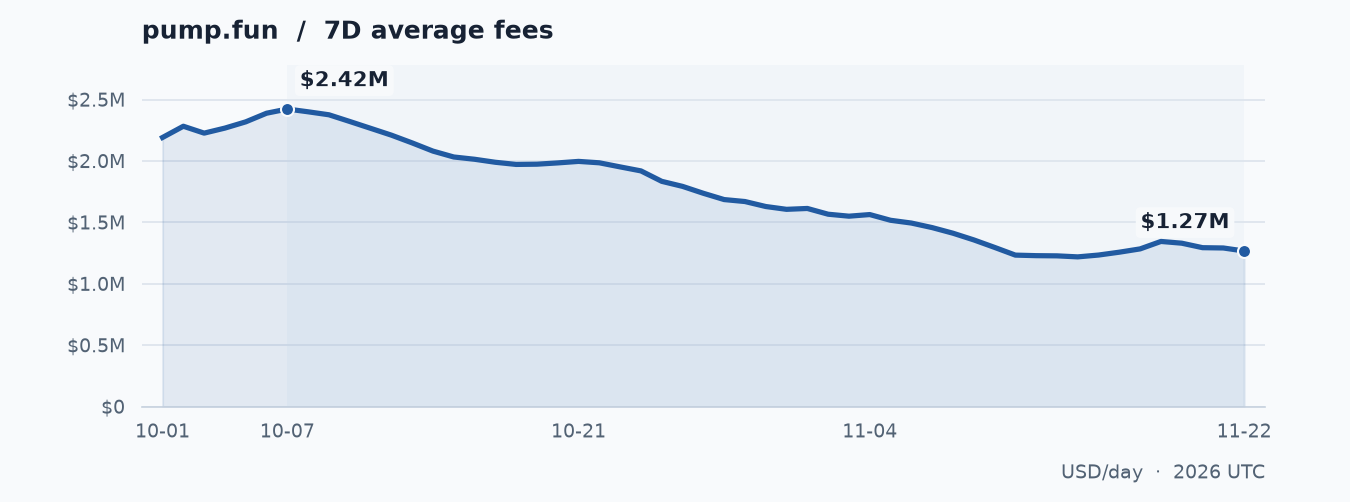
The chart uses DefiLlama's pump.fun project fees in USD per day. Each point averages the UTC day and the six days before it. It covers October 1 to November 22, 2026. DefiLlama source series
The original market snapshot at 00:40 UTC on November 24, 2026 put PUMP at $0.00253, market cap at $893 million, and its 30-day return at −41.3%. In the original fee snapshot, the seven-day average was $2.44 million and $1.29 million per day for the windows ending October 7 and November 22, respectively, a decline of about 47%. Single-day fees on October 1 and November 22 were $2.40 million and $940,000. Recalculating from the public project series gives seven-day averages of $2,422,427.71 and $1,266,429 per day, down 47.72%, and daily fees of $2,400,773 and $955,779. The readings differ slightly. Both show fees falling. CoinGecko reference prices · DefiLlama source series
On April 28, pump.fun estimated that roughly 50% of platform revenue would fund PUMP buybacks and burns. Protocol fees and platform revenue are measured differently. Lower trading fees can put pressure on the funds available for buybacks. Email and social accounts also give the platform a channel for outreach, re-engagement, and tailored service. When trading slows, keeping repeat traders matters more than adding wallet addresses. pump.fun April 28 announcement · Buyback and burn coverage
What the platform controls
The November 16 version of the terms sets eligibility rules for individual products. Section 30B.2 lists perps as a restricted feature and covers the US, Ontario in Canada, sanctioned jurisdictions, and people Hyperliquid defines as restricted, among others. Section 30E.2 restricts access to prediction markets for US users and others. Section 30D.5 adds restrictions for certain assets linked to securities traded via the Pump Bridge, covering the US, the UK, the European Economic Area (EEA), Switzerland, and Canada, among other jurisdictions. The terms allow wallet screening. In September, the Pump App was reported to be temporarily unavailable in the US and Indian App Stores. pump.fun Terms of Use · App Store removal coverage
Email and social sign-in give the platform accounts it can recover, restrict, and operate over time. Geofencing and on-chain screening are also possible with wallet-based sign-in. Unified accounts help the website and app apply the same eligibility rules and retain access records. The notice did not cite compliance as a reason for the switch. Given the products and the terms, I think it is likely one of the longer-term motivations.
Phantom has an in-app browser and offers perps of its own. Its browser can be the first place a user opens a trading app. That makes Phantom a potential competitor for distribution. When the trading wallet sits inside its own account system, pump.fun controls the default funding path, fee routing, and rewards. Privy announced it was joining Stripe in June 2025 and has named Hyperliquid, OpenSea, and Farcaster as users of its platform. This account and wallet infrastructure already serves consumer financial apps. Phantom in-app browser · Phantom perps documentation · Privy and Stripe announcement · Privy adoption examples
The cost to users
Karpelès pointed to two issues. Users first have to trust the import interface they give the key to. They then have to trust that the receiving system is the intended one and the isolation of Privy's TEE. Platform access depends on the email or social identity as well as the wallet's authorization settings. Account takeover, a ban, a court order, or compliance restrictions can affect signing and recovery within the platform. Users who retain the original key still have an independent way to use the old address. Closing a platform account does not rotate the key on-chain. The public materials do not establish how long the provider retains it after deletion. SIWS can link a profile while keeping an external wallet self-custodial. The platform gets different permissions with a key import. Coverage of Karpelès's criticism · Privy wallet policies and controls
Section 12.2(c) says the platform will never ask users to share a wallet private key, seed phrase, or social and email credentials. Section 30.1 puts responsibility for the Privy wallet generated at sign-in on Privy and the user. It says the Pump entities do not control wallets or private keys. The migration notice asks users to import the original key through the official flow. An audit could check who receives the key, who can authorize signing, what recovery looks like under restrictions, and how the flow fits those promises. pump.fun Terms of Use · pump.fun migration notice
Key export helps users access the wallet independently. It does not change the fact that the same key has already been imported. Users may also never make a separate backup. Ledger and multisig users cannot keep their old account through the import route. The notice directs them to open a new account. The cutoff comes about eight days after the announcement date. Old sessions can still show the migration prompt. The pressure comes mainly from the deadline for signing in directly with an external wallet. pump.fun migration notice
Conclusion
pump.fun is moving from a product entered through a wallet address to an account it can use to serve and retain consumers. Shared sign-in across web and app is the immediate change for users. Perps, multichain support, deposits, retention, and product eligibility could explain the longer-term choice. If pump.fun wants an embedded wallet to sign directly for an existing address, key import is the part of its implementation that most needs independent verification.
The platform should publish signing permissions, recovery conditions, and a verifiable security audit. Users who need to migrate can retain independent access via the official export path and keep only trading funds at the migrated address. For larger holdings, use a separate key in Phantom or a hardware wallet. Ledger and multisig users who still want to use pump.fun can open a separate trading account and keep the original wallet for safekeeping.